
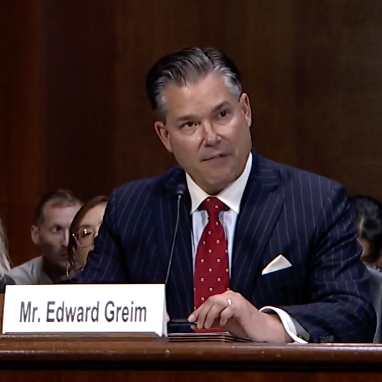
Center for Election Confidence (CEC) Board Member Edward “Eddie” D. Greim, Esq., a nationally recognized constitutional and election law attorney who twice argued Louisiana v. Callais before the U.S. Supreme Court, testified before the U.S. Senate Judiciary Committee’s Constitution Subcommittee concerning enforcement of the landmark decision.

Edward “Eddie” D. Greim, Esq., CEC Board Member (U.S. Senate)
Greim, a partner at Graves Garrett Greim whose practice spans complex litigation, free speech, election law, redistricting, and constitutional appeals, brought firsthand experience to the hearing: he was instrumental in securing the Supreme Court ruling that clarified the constitutional limits on race-based redistricting. In his written testimony, Greim described Callais as as “one of the most significant election law decisions—indeed, one of the most significant Fourteenth and Fifteenth Amendment decisions—of the past several decades,” adding that it “should end the drawing of legislative districts based on race.”
[Callais] should end the drawing of legislative districts based on race
Greim’s testimony framed Callais as a decision that resolves an “unnecessary tension” that lower courts had created between the Fourteenth Amendment’s command of equal treatment and the Fifteenth Amendment’s prohibition on racial discrimination in voting. Properly understood, he explained, those Reconstruction Amendments are not competing guarantees to be “weaponized” against one another, but complementary protections that should “mesh together seamlessly to protect all citizens regardless of race.”
During the hearing, Greim sharpened that point: “Requiring proof of these three factors ensures that the 14th and 15th Amendments operate as . . . a seamless web of protection for voters.”
Requiring proof of these three factors ensures that the 14th and 15th Amendments operate as . . . a seamless web of protection for voters.
In other words, Callais does not weaken voting-rights protections; it restores them to their constitutional foundation by ensuring that courts and legislatures do not treat voters as racial blocs rather than citizens.
Greim identified three principal lessons from Callais.
First, race cannot be used as a districting factor: districts must satisfy traditional, non-racial redistricting criteria and legitimate political goals.
Second, racially polarized voting must be shown to stem from racial animus, not merely from the fact that different racial groups may tend to vote differently.
Third, there must be objective evidence showing a likelihood of intentional racial discrimination in the area where a proposed remedial district is drawn.
As Greim put it during the hearing, “There was no Gingles majority . . . for the principle that racial intent doesn’t matter in polarized voting.” And in his written testimony, he was equally direct about implementation: “Districts that fail this test violate the Fourteenth Amendment and Fifteenth Amendment.”
Greim also made clear what Callais does, and does not, do. “Districts are not suspect and subject to challenge merely because they are majority-minority districts,” he wrote, and districts that were truly necessary to remedy recent intentional race discrimination “should survive until the underlying racial discrimination dissipates.”
Districts are not suspect and subject to challenge merely because they are majority-minority districts.