
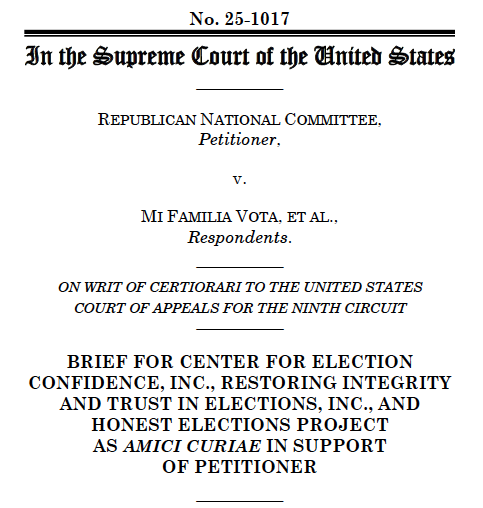
The Center for Election Confidence (CEC) filed a joint amicus brief before the U.S. Supreme Court in Republican National Committee v. Mi Familia Vota (No. 25-1017) with partners Honest Elections Project (HEP) and Restoring Trust and Integrity in Elections (RITE), urging the U.S. Supreme Court to reverse the Ninth Circuit’s decision restricting Arizona’s ability to require documentary proof of citizenship and to remove improperly registered noncitizens from its voter rolls. The brief argues that the Ninth Circuit’s interpretation of the National Voter Registration Act (NVRA) “strips States of the authority to enforce the voter qualifications they alone may set.”
CEC and its partners first argue that the NVRA does not prohibit Arizona from requiring documentary proof of citizenship on its state voter-registration form. Although states must “accept and use” the federal registration form, Congress expressly recognized their authority to “develop and use” state-specific forms. As the brief emphasizes, the Supreme Court has already confirmed that “state-developed forms may require information the Federal Form does not,” specifically identifying Arizona’s proof-of-citizenship requirement as an example.
The brief argues that the Ninth Circuit reached the opposite conclusion by misreading the NVRA’s requirements that information on state forms be “necessary” to determine eligibility and that certain state forms be “equivalent” to the federal form. CEC and its partners argue that, under Arizona law, documentary evidence of citizenship is “necessary” because election officials must reject applications that lack satisfactory proof. Therefore, a citizenship attestation or checkbox by definition cannot satisfy Arizona’s documentary proof requirement. Otherwise, the Ninth Circuit’s reasoning would allow the NVRA’s attestation requirement to swallow state authority to set voter qualifications.
CEC and its partners similarly reject the Ninth Circuit’s conclusion that “equivalent” means a state form must be “virtually identical” to the federal form. The brief explains that Congress placed the term in a provision discussing distribution of voter registration forms by public agencies and not in the section governing what information state forms may contain. Reading this ancillary provision as an independent substantive restriction, the organizations argue, effectively collapses the distinction between federal and state registration forms and would “practically eliminat[e] a State’s authority to use its own Form.”
The brief further warns that the Ninth Circuit’s interpretation raises “serious constitutional doubts” because while the Constitution permits Congress a limited role in the regulation of federal elections, the authority to set voter requirements and qualifications lies with the states. Quoting Arizona v. Inter Tribal Council, 570 U.S. 1 (2013), CEC and its partners stress that “the power to establish voting requirements is of little value without the power to enforce those requirements.” Preventing Arizona from obtaining the information it considers necessary to verify citizenship would therefore interfere with the State’s constitutional authority to determine who is qualified to vote.
CEC, HEP, and RITE next challenge the Ninth Circuit’s application of the NVRA’s 90-day restriction on systematic voter-list maintenance. The brief argues that the provision was designed to regulate removal of voters who were properly registered but later became ineligible because of circumstances such as a change of residence—not to force states to retain on the voter rolls individuals who were never eligible to register at all. Under the Ninth Circuit’s reasoning, the election integrity organizations warn, states could be prevented from removing “noncitizens, minors, and fictitious persons” whose registrations were invalid from the outset. The brief calls that interpretation an “absurd result” that would threaten state sovereignty and confidence in elections.
The brief points to recent examples illustrating the practical consequences of that interpretation. New Jersey discovered that at least 6,600 noncitizens had been erroneously registered through its motor-vehicle system, while similar registration problems have occurred in Illinois and Oregon. The partner organizations argue that the NVRA cannot reasonably be interpreted to require states to leave such registrations untouched, particularly when the statute expressly identifies protecting the voting rights of “eligible citizens” and maintaining accurate voter rolls among its central purposes.
Finally, CEC, HEP, and RITE argue that preventing states from removing registrations of persons who were never qualified to vote threatens citizens’ right to have their ballots counted at full value. “Each illegal vote cancels out a proper one,” the brief explains, and once an unlawful ballot has been cast and counted, the resulting dilution generally cannot be undone. Quoting the Supreme Court, the organizations emphasize that “[t]he right of suffrage can be denied by a debasement or dilution of the weight of a citizen’s vote just as effectively as by wholly prohibiting the free exercise of the franchise.”
CEC, HEP, and RITE urge the Supreme Court to reverse the Ninth Circuit, preserve Arizona’s authority to enforce its voter qualifications, and reject an interpretation of the NVRA that would prevent states from removing voter registrations that were never valid.
As the brief concludes, the decision below threatens not only the accuracy of voter rolls, but “the integrity of self-government itself.”
The Center for Election Confidence thanks Christopher E. Mills of Spero Law LLC for his representation in this matter.